
The timber industry, always looking for technology that improves its processes, is seeing a major shift in log moisture measurement. This progress comes from statistical models that relate relative electrical permittivity (ε’) and the dielectric loss factor (ε”) to the amount of water in the wood. These models are the basis of instant moisture measurement methods, a key need in the modern timber industry.
The study with pine and eucalyptus logs
Such models had already been applied successfully to moisture measurement in sawn timber and wood chips, but had not been explored for roundwood. This study set out to fill that gap by evaluating the models on pine and eucalyptus logs with moisture content between 10% and 60% on a wet basis. The results showed good coefficients of determination (R²): 0.883 for pine logs and 0.681 for eucalyptus logs.
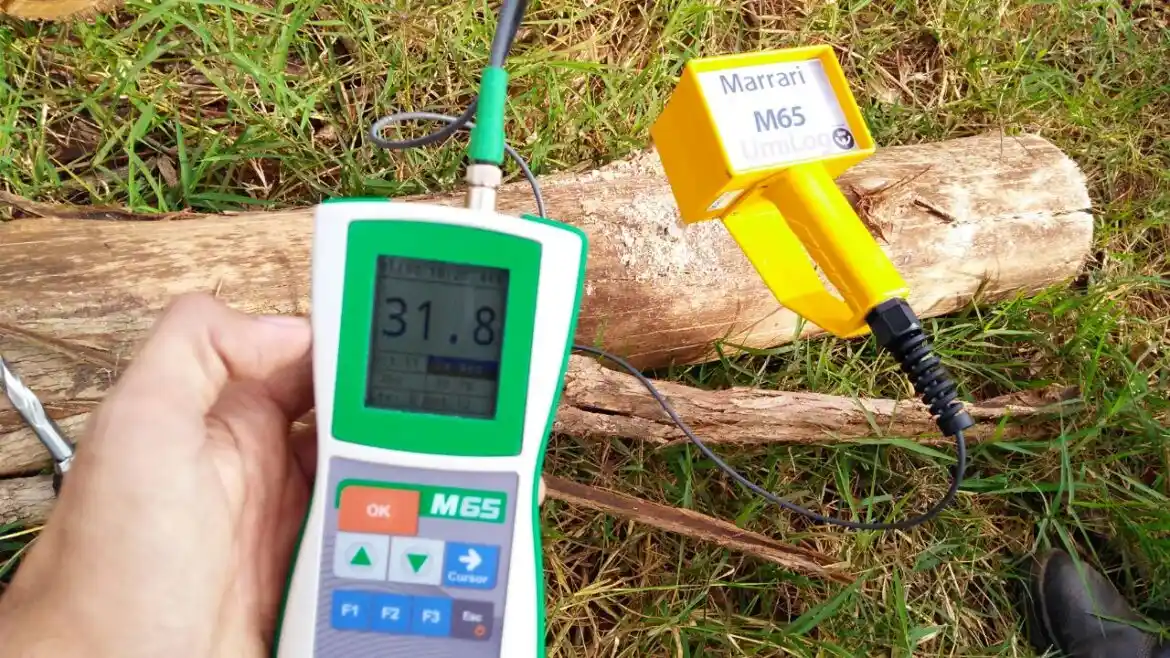
The correlation between the primary reading of a capacitive sensor inserted into the logs and the wood moisture measured by the gravimetric
Applications in the timber industry
The practical applications are broad. With capacitive meters such as UmiLog, the method can change the way the industry handles its logs. From selecting the logs that feed a pulp line to those destined for the power boiler, the capacitive method offers a tool for trading and grading raw material more efficiently.
The study is a technical advance and also an opportunity to improve operational efficiency and promote more sustainable practices in the timber industry. The accuracy achieved shows its potential to optimize processes, reduce waste and manage natural resources better.
Conclusion
This study is a milestone on the timber industry’s path toward technological innovation. Being able to apply instant moisture measurement to logs opens a new perspective on how this industry handles its raw material. The future of log moisture measurement looks bright, driven by science, technology and the growing need for efficiency and sustainability.
Did you like this article?
Could this article help someone on your team? Send the link to a colleague: