
Wherever drying is the main topic, the terms dry bulb and wet bulb come up constantly. The
How are these temperatures measured? What care is needed to get correct readings? How is it done in practice? To understand it better, it helps to know a few basic concepts.
Ambient (dry-bulb) temperature
This is the air temperature where the thermometer is installed. It is the same as the
Wet-bulb temperature
It is the temperature you feel when your skin is wet and exposed to moving air.
A
Relative humidity
This is the amount of water vapor in the air compared with the maximum that air could hold at that temperature, expressed as a percentage. At 100% relative humidity, the air cannot take up more moisture without condensation.
To put numbers on it:
Absolute humidity
Absolute humidity, on a volume basis, is the mass of water vapor in a given volume of air, usually expressed in grams per cubic meter (g/m³) or, in SI units, kg/m³. If all the water in a cubic meter of air were condensed into a container, it could be weighed to quantify absolute humidity.
Using the previous example, air with an absolute humidity of
Equilibrium moisture content
When a hygroscopic material (such as wood, paper, grain or
How to measure these quantities correctly
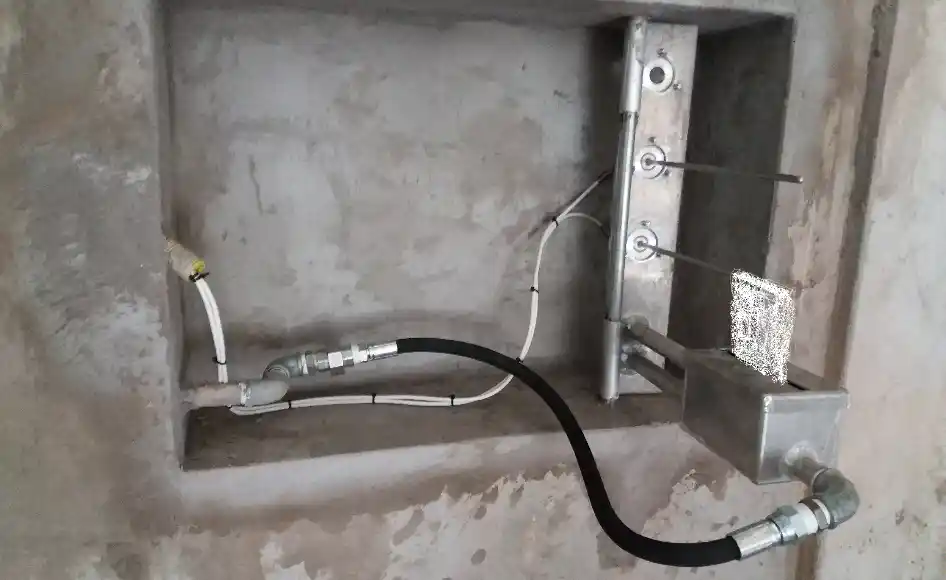
Here we cover the devices used to measure these quantities inside a wood drying kiln.
- Dry bulb: measured with Pt100 sensors, platinum resistors whose resistance rises almost linearly with temperature. The sensor sits in a
stainless-steel thermowell and is connected to an electronic module that converts the resistance into an electrical signal for the indicator or control system. - Wet bulb: uses the same sensor as the dry bulb, but the thermowell is wrapped in a cotton wick dipped in a container of water at ambient temperature. It is read the same way as the dry bulb.
- Relative humidity: can be measured directly with capacitive or lithium chloride sensors, or calculated from
dry-bulb andwet-bulb readings with a psychrometric chart. - Equilibrium moisture content: can be calculated or measured with a resistive sensor, similar to wood moisture meters.
- Absolute humidity: measured mainly in
high-temperature processes, where the psychrometric chart does not give reliable values. Direct methods use ultrasonic velocity sensors and capacitive sensors mounted on ceramic substrates.
Measurement best practice
Some important points for good
- Use
good-quality sensors with good linearity between temperature and resistance, sealing suited to the process (to keep moisture out) and three- orfour-wire connection. - Install the sensors where the airflow is representative and continuously renewed.
For
- The sensor must be covered by a cotton wick dipped in a container of water.
- The wick must cover the part of the thermowell that houses the temperature sensor, normally the tip (4
to 5 cm from the end). - The distance from the sensor stem to the surface of the wetting water should be around
10 cm. - The water container should have a float mechanism that keeps the level constant and avoids continuous water replacement.
- The wet bulb must be exposed to the airflow passing through the drying stacks. A wet bulb installed outside that flow will give wrong readings, leading to poor drying.
Marrari kiln controllers and drying managers measure dry and wet bulb and run the process automatically. See our drying kiln management solutions.
Author: Celso Martini, Sales Director at Marrari Automação
Did you like this article?
Could this article help someone on your team? Send the link to a colleague: